Got word that Goliatha made it home to Bryan, Ohio, safe and sound.
Still waiting for pictures from California and Vermont, but Dani reports that the dragon is happy to not have to be stuffed into a box for days and days to get from one place to another.
Sunday, April 19, 2009

Wednesday, April 8, 2009
Traveling coming to an end
Goliatha left California for its final visit before heading home to Ohio.
Dan's Uncle Doug and Aunt Diane played host to Goliatha in sunny southern California. (Pictures are coming soon.)
From California Dani's cousin Phil will take Goliatha around the Burlington, Vermont, area for a few days. How knows, she may even get into one of Phil's classes at the University of Vermont.

From Vermont Goliatha heads back to Ohio.
Let's review where Goliatha has been:
And that is just the mileage between the actual places Goliatha visited. If you want to look at the actual number of miles she traveled, you have look at how the mail works in and out of many of the countries she visited. For example, to go to Iraq Goliatha first had to go through Miami, Florida. The same is true of its route from Iraq to Togo and then to Peru and finally to California.
And you have to look at how its flights were affected by transfers.
So the actual miles Goliatha traveled looks more like this:
Dan's Uncle Doug and Aunt Diane played host to Goliatha in sunny southern California. (Pictures are coming soon.)
From California Dani's cousin Phil will take Goliatha around the Burlington, Vermont, area for a few days. How knows, she may even get into one of Phil's classes at the University of Vermont.

From Vermont Goliatha heads back to Ohio.
Let's review where Goliatha has been:
- Bryan to Ypsilanti, Michigan - 72 miles
- Ypsilanti to Beloit, Wisc. - 277 miles
- Beloit to Chicago, Ill. - 85 miles
- Chicago to Brasilia, Brazil - 4,862 miles
- Brasilia to Baghdad, Iraq - 6, 760 miles
- Baghdad to Lome, Togo - 3,230 miles
- Lome to Lima, Peru - 5,450 miles
- Lima to Oxnard, Calif. - 4,222 miles
- Oxnard to Burlington, Vermont - 2,520 miles
- Burlington back to Bryan - 610 miles
And that is just the mileage between the actual places Goliatha visited. If you want to look at the actual number of miles she traveled, you have look at how the mail works in and out of many of the countries she visited. For example, to go to Iraq Goliatha first had to go through Miami, Florida. The same is true of its route from Iraq to Togo and then to Peru and finally to California.
And you have to look at how its flights were affected by transfers.
So the actual miles Goliatha traveled looks more like this:
- Bryan to Ypsilanti, Michigan - 72 miles
- Ypsilanti to Beloit, Wisc. - 277 miles
- Beloit to Chicago, Ill. - 85 miles
- Chicago to Sao Paulo, Brazil - 5,219
- Sao Paulo to Brasilia, Brazil - 525 miles
- Brasilia to Miami, Florida - 3,765 miles
- Miami to Baghdad, Iraq - 6,963 miles
- Baghdad to Miami - 6.963 miles
- Miami to Lome, Togo - 5,500 miles
- Lome to Miami - 5,500 miles
- Miami to Lima, Peru - 2,620 miles
- Lima to Miami - 2,620 miles
- Miami to Oxnard, Calif. - 2,390 miles
- Oxnard to Burlington, Vermont - 2,520 miles
- Burlington back to Bryan - 610 miles
Sunday, February 22, 2009
Goliatha visits a museum and learns about the Incas
Before the Spanish came Peru has a strong empire and a lot of gold.  At its height, the Inca empire stretched from Argentina to Ecuador. You can see on the map to the right just how big this empire was.
The Inca empire started around 1200 AD. It finally faded away by the late-1500s because of the Spanish invaders.
One of the most famous places in Peru from the Inca period is Machu Picchu. In the local language "Machu Picchu" means "OldPeak." It is a pre-Columbian (that means before Christopher Columbus landed in the New World) site located 8,000 feet above sea level.
It is on a mountain above the Urubamba Valley in Peru, about 50 miles northwest of the major city Cuzco. Nearby is the Urubamba River, which is one of the rivers that later becomes the Amazon River.
Machu Pichu was was built around 1460 AD but was abandoned by the Inca rulers a hundred years later at the time of the Spanish conquest of the Inca Empire.
The site was well known by the local people but after the Spanish conquest, Machu Picchu was forgotten by the rest of the world. It wasn't until 1911 that the American historian Hiram Bingham wrote about the site and made it well-known again.
Since 1911 Machu Picchu has been an important tourist attraction. It was declared a a UNESCO World Heritage Site in 1983. There are concerns about the effect of tourism on the site as it reached 400,000 visitors in 2003.
One of the things the Inca were famous for was their gold work. They made jewelry and masks and other decorative items. Some of the things made were to honor the gods the Inca worshiped. Some of the stuff was used for the high leaders of the society. And other items were made to be buried with the leaders.
On the right you can see Goliatha with an Inca gold mask at the national museum in Lima.
Besides gold, the Inca made a lot of beautiful pottery. Here is Goliatha with some of the pottery as seen in the national museum.
![Reblog this post [with Zemanta]](https://lh3.googleusercontent.com/blogger_img_proxy/AEn0k_u418BxpKukrqjlYGjFPOA5nJvEoctMSAmjRx-MF38foeOQzZiDz9j9h2GGY2NJm255aNsB90bdyXGl204HoEuDLTFcZOHr30MYdu8ko_kx_QcWn4B2vm_9T3fSSGTb_KNDtFIqNxsnlZgPv6hbRHQ=s0-d)
 At its height, the Inca empire stretched from Argentina to Ecuador. You can see on the map to the right just how big this empire was.
The Inca empire started around 1200 AD. It finally faded away by the late-1500s because of the Spanish invaders.
One of the most famous places in Peru from the Inca period is Machu Picchu. In the local language "Machu Picchu" means "OldPeak." It is a pre-Columbian (that means before Christopher Columbus landed in the New World) site located 8,000 feet above sea level.
It is on a mountain above the Urubamba Valley in Peru, about 50 miles northwest of the major city Cuzco. Nearby is the Urubamba River, which is one of the rivers that later becomes the Amazon River.
Machu Pichu was was built around 1460 AD but was abandoned by the Inca rulers a hundred years later at the time of the Spanish conquest of the Inca Empire.
The site was well
 known by the local people but after the Spanish conquest, Machu Picchu was forgotten by the rest of the world. It wasn't until 1911 that the American historian Hiram Bingham wrote about the site and made it well-known again.
Since 1911 Machu Picchu has been an important tourist attraction. It was declared a a UNESCO World Heritage Site in 1983. There
 are concerns about the effect of tourism on the site as it reached 400,000 visitors in 2003.
One of the things the Inca were famous for was their gold work. They made jewelry and masks and other decorative items. Some of the things made were to honor the gods the Inca worshiped. Some of the stuff was used for the high leaders of the society. And other items were made to be buried with the leaders.
On the right
 you can see Goliatha with an Inca gold mask at the national museum in Lima.
Besides gold, the Inca made a lot of beautiful pottery. Here is Goliatha with some of the pottery as seen in the national museum.
A note about Lima from a friend
The following was written by Charisse Phillips, who is currently looking after Goliatha:
Lima is an old city. It was a big city nearly one hundred years before the Pilgrims even landed at Plymouth Rock. It has many grand buildings, since it was the capital of the whole Spanish empire in South America. The buildings don't always look so old, though, because Lima has had so many really big earthquakes that a lot of the buildings fell down. They were rebuilt each time. You can see that some of the buildings are pink and yellow. Lima is in the tropics so there a lots of palm trees too.
People in Lima speak Spanish. They like to eat seafood, rice, corn and sweet potatoes. They drink Inca Cola. It tastes like bubble gum.
Lima is right on the ocean but it is in a desert with no trees or grass at all. It has two rivers that are filled during the summer with the rain water from the far away Andes mountains. When it is summer in Lima it is winter in the United States. More than 11 million people live in Lima. That is the size of New York City. Lima has some islands and a short boat trip takes you to see wild penguins and sea lions that live on the islands.
Charisse Phillips
Lima is an old city. It was a big city nearly one hundred years before the
 Pilgrims even landed at Plymouth Rock. It has many grand buildings, since it was the capital of the whole Spanish empire in South America. The buildings don't always look so old, though, because Lima has had so many really big earthquakes that a lot of the buildings fell down. They were rebuilt each time. You can see that some of the buildings are pink and yellow. Lima is in the tropics so there a lots of palm trees too.
People in Lima speak Spanish. They like to eat seafood, rice, corn and sweet potatoes. They drink Inca Cola. It tastes like bubble gum.
Lima is right on the ocean but it is in a desert with no trees or grass at all. It has two rivers that are filled during the summer with the rain water from the far away Andes mountains. When it is summer in Lima it is winter in the United States. More than 11 million people live in Lima. That is the size of New York City. Lima has some islands and a short boat trip takes you to see wild penguins and sea lions that live on the islands.
Charisse Phillips
Saturday, February 21, 2009
Visiting Lima, Peru
First, I better explain how you pronounce the capital city of Peru.
It is spelled L-I-M-A. It is pronounced LEE-ma. (So it is not like the beans that we all hate. Those are pronounced LIE-ma.)
Charisse Phillips and her family did a great job showing me around the city.
Lima really has a lot of history.
It was founded by the Spanish conquistador Francisco Pizarro on January 18, 1535, as La Ciudad de los Reyes, or "The City of Kings." It became the most important city in the Spanish Vice-royalty of Peru and after independence in 1821 became the country's capital.
Independence was not easy to earn.
The Spanish wanted to keep all their colonies in South America but more and more South Americans wanted independence. Two famous independence leaders were Jose de San Martin and Simon Bolivar. (If you go to Washington, DC you can see statues of these men not far from the U.S. State Department.)
Even though San Martin proclaimed Peruvian independence July 28, 1821, it still took another four years before the Spanish were kicked out of South America and all the countries could have their own governments.
And what we know today as the many countries of South America is not what was around in the 1800s.
What the Spanish thought of as Peru is what we now call Peru and Bolivia. And large portions of Chile. (And if you think the name of the country BOLIVIA sounds like the liberator BOLIVAR, there is a reason. The country was named for Simon Bolivar.)
In 1837 Bolivia and Peru tried to have a joint country but that failed after a couple of years because of attacks from Chile.

Peru is also along what is called the "Ring of Fire." This means that a lot of earthquakes can happen -- and do.
In 1940 most of the city was destroyed by an earthquake. Other earthquakes happened just about every 10 years in Peru.
Dani's aunt Lisa was in Lima in the 1970s when another powerful earthquake hit.
Earthquakes in Peru have been recorded back more than 400 years, to 1553. The first real description of an earthquake, however, came in 1582. The tales told of a terremoto that killed 30 people and destroyed much of Arequipa.
You can learn more about Peru and its earthquakes here.
For the Catholics among the readers, Lima even has its own saint. St. Martin de Porres was born in 1579 and canonized in 1962.
So, with lots of history to the city of Lima and to the country of Peru, you have to figure there are lots of interesting places to visit.
And you would be right
Here I am at a crypt in the national cathedral. Charisse says this is always a popular place for kids to visit.
And below is a picture of me in front of the cathedral. This was church was started in 1535. So it is really really old.
Because of all the earthquakes the cathedral was damaged a lot and then fixed up. There were also times when money was tight and so some important repairs had to be put off. And we all know that when a problem is not fixed right away it becomes a bigger problem later. So there were times when the cathedral had be be closed because it was too dangerous to let people in.
The cathedral is in the city's main square called the Plaza de Armas.
 This is the place where San Martin declared Peru's independence. And when he did that the plaza was already about 300 years old. So the plaza is almost as old as the city.
I'm going to stop here because this is a lot of information for just one posting.
I'll have some more pictures and facts including a neat picture of me with a solid gold mask!
How cool is that?
![Reblog this post [with Zemanta]](https://lh3.googleusercontent.com/blogger_img_proxy/AEn0k_vQwdX46ReDnh_qeUIgeSodoLz1ehjocsPKXykV6dhTSYsruotaHrTgAhSovHwIkczp5zOf3EO_oQkEHBoUnVkLLhAv-JZ93N6gDjvSkL4uK6vSw-mNuWDiOqblBT5MdxWUImOUhUZuuVS3lmYbu9qq=s0-d)
It is spelled L-I-M-A. It is pronounced LEE-ma. (So it is not like the beans that we all hate. Those are pronounced LIE-ma.)
Charisse Phillips and her family did a great job showing me around the city.
Lima really has a lot of history.
It was founded by the Spanish conquistador Francisco Pizarro on January 18, 1535, as La Ciudad de los Reyes, or "The City of Kings." It became the most important city in the Spanish Vice-royalty of Peru and after independence in 1821 became the country's capital.
Independence was not easy to earn.
The Spanish wanted to keep all their colonies in South America but more and more South Americans wanted independence. Two famous independence leaders were Jose de San Martin and Simon Bolivar. (If you go to Washington, DC you can see statues of these men not far from the U.S. State Department.)
Even though San Martin proclaimed Peruvian independence July 28, 1821, it still took another four years before the Spanish were kicked out of South America and all the countries could have their own governments.
And what we know today as the many countries of South America is not what was around in the 1800s.
What the Spanish thought of as Peru is what we now call Peru and Bolivia. And large portions of Chile. (And if you think the name of the country BOLIVIA sounds like the liberator BOLIVAR, there is a reason. The country was named for Simon Bolivar.)
In 1837 Bolivia and Peru tried to have a joint country but that failed after a couple of years because of attacks from Chile.
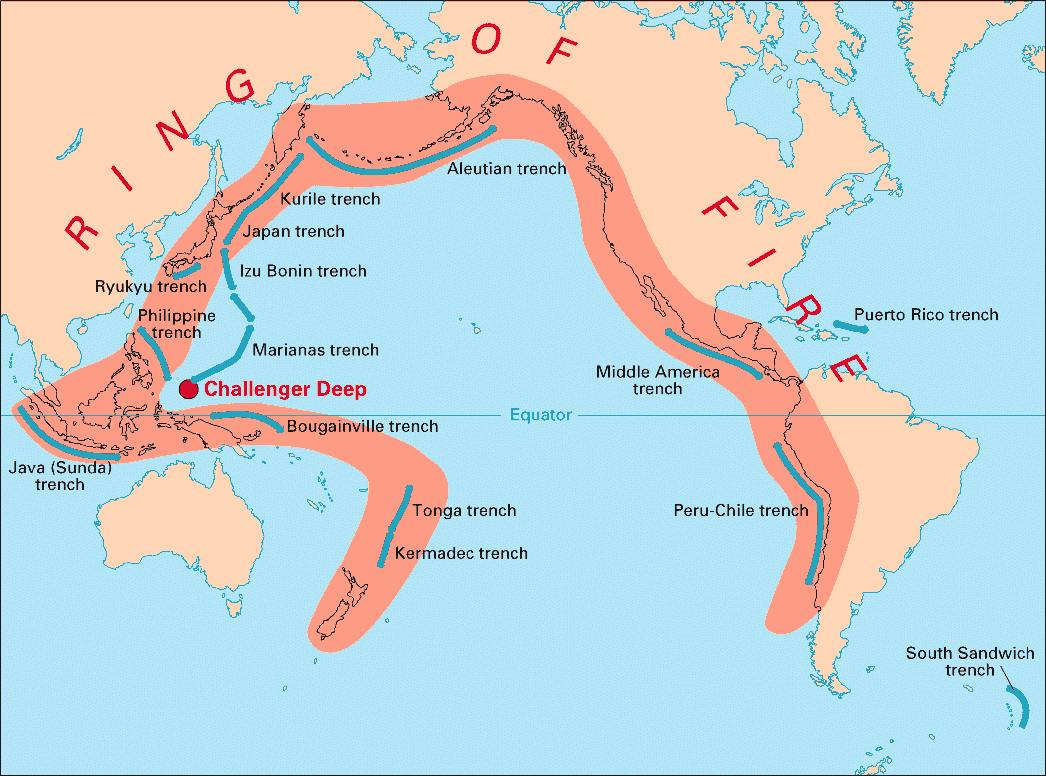
Peru is also along what is called the "Ring of Fire." This means that a lot of earthquakes can happen -- and do.
In 1940 most of the city was destroyed by an earthquake. Other earthquakes happened just about every 10 years in Peru.
Dani's aunt Lisa was in Lima in the 1970s when another powerful earthquake hit.
Earthquakes in Peru have been recorded back more than 400 years, to 1553. The first real description of an earthquake, however, came in 1582. The tales told of a terremoto that killed 30 people and destroyed much of Arequipa.
You can learn more about Peru and its earthquakes here.
For the Catholics among the readers, Lima even has its own saint. St. Martin de Porres was born in 1579 and canonized in 1962.

So, with lots of history to the city of Lima and to the country of Peru, you have to figure there are lots of interesting places to visit.
And you would be right
Here I am at a crypt in the national cathedral. Charisse says this is always a popular place for kids to visit.
And below is a picture of me in front of the cathedral. This was church
 was started in 1535. So it is really really old.
Because of all the earthquakes the cathedral was damaged a lot and then fixed up. There were also times when money was tight and so some important repairs had to be put off. And we all know that when a problem is not fixed right away it becomes a bigger problem later. So there were times when the cathedral had be be closed because it was too dangerous to let people in.
The cathedral is in the city's main square called the Plaza de Armas.
 This is the place where San Martin declared Peru's independence. And when he did that the plaza was already about 300 years old. So the plaza is almost as old as the city.
I'm going to stop here because this is a lot of information for just one posting.
I'll have some more pictures and facts including a neat picture of me with a solid gold mask!
How cool is that?
Goliatha enjoying Peruvian charms
(Here is a note from Charisse Phillips in Lima, Peru. Charisse is Goliatha's host in Peru.)
Goliatha went to the beach for a summer day, just like most Limenos do.
Here she is at Bikini Beach in the town of Punta Negra.
These black rocks were formed by volcanic activity are are super sharp, so Goliatha had to be pretty careful.
The Pacific waves are not at all peaceful here - the waves are quite wild and there's a strong undertow. But Goliatha got to see pelicans, sea gulls, cormorants and Peruvian boobies, which dive deep into the sea for fish. Goliatha couldn't believe that there's a great sandy desert right on the edge of the ocean in Peru. There was nothing green growing on the hills along the road to the beach.
She thought it looked like the Sahara.
![Reblog this post [with Zemanta]](https://lh3.googleusercontent.com/blogger_img_proxy/AEn0k_v_C6CabPfeidWY8BJFtXuhPhdx_Y7X4tE0xfGqv3V1R44l_bf_aIYrPFHoWFoVlIu8brRSHnlLpnB6JQVzVSZY90wUGNsfh98kAY6UqYiLDxZLbBQLpM13xsy9XESIxXZAiuFOa466v8WtgrtbmiWj=s0-d)
Goliatha went to the beach for a summer day, just like most Limenos do.
Here she is at Bikini Beach in the town of Punta Negra.

These black rocks were formed by volcanic activity are are super sharp, so Goliatha had to be pretty careful.
The Pacific waves are not at all peaceful here - the waves are quite wild and there's a strong undertow. But Goliatha got to see pelicans, sea gulls, cormorants and Peruvian boobies, which dive deep into the sea for fish. Goliatha couldn't believe that there's a great sandy desert right on the edge of the ocean in Peru. There was nothing green growing on the hills along the road to the beach.
She thought it looked like the Sahara.
Friday, February 13, 2009
Made it to Lima, Peru
 Just arrived in Lima, Peru, after about a month of traveling from Lome, Togo. (And some people think the mail is slow when it takes a couple of days for a letter to get across town!)
I am now the guest of Charisse and Greg Phillips. They both work for the U.S. embassy in Lima.
Peru is on the west coast of South American. It is next to Brazil, Chile, Bolivia, Colombia and Ecuador. (If you click on the map on the right, you can see a bigger version of it.)
The Andes Mountains go right through the country. And these are very very high mountains.
One of the most famous places in Peru is at the top of the mountain range.
The place is called Machu Pichu.
It was the ancient home of the Incas.
Here is a picture of the place.

I have already learned there are lots of interesting things about Peru.
To begin with, Peruvians claim the potato was first cultivated here. Not in Idaho or Ohio or Michigan but in Peru.
Pretty cool huh?

Peru also has some very weird animals. Here is a picture of a llama. (If you say that word in English the first two letters sound like an "L" but in Spanish the sound like a "Y." So in Spanish what English speakers call a LAMA, the Peruvians call a "YA-ma."
Saturday, January 10, 2009
Goliatha and Embassy Wheels in Togo

Here I am on the hood of one of the U.S. embassy cars in Lome, Togo.
Don't worry. I did not take a ride ON the car, just in it.
Dragon sunbathing in Africa

Here is Goliatha taking it easy at the U.S. ambassador's swimming pool in Lome, Togo.
A note from Togo
January 5, 2009
Hello everyone. Goliatha arrived here in Togo just in time for the end-of-year holidays. Togo is a very small and poor country in West Africa. It is on the coast of the Gulf of Guinea, which is part of the Atlantic Ocean. The capital city is Lomé (pronounced Lo-mey). Togo was a colony of Germany, Great Britain and France, one after the other. That is why the official language is French. It has been independent since 1960 and has been striving toward democracy ever since. Since 1963 it has been ruled by the same family, the Gnassingbé s, first the father, Eyadéma, and now the son, Faure.
I am the American Ambassador to the Togolese Republic, and a friend of Danika’s Uncle Dan and Aunt Lisa. We all served together in the Dominican Republic. Goliatha joined me and my husband and daughter here at the Ambassador’s Residence for some vacation time – which she needed after all her travels. We lounged around the pool, and went shopping. It was hard to take pictures out on the streets, since most people in African countries don’t like to have their picture taken and won’t give their permission. (They think it diminishes their souls.) Also, since Togo has many military sites there are restrictions on taking pictures in public places. We did get some good shots of Goliatha at the U.S. Embassy and riding in the Ambassador’s car with the official flags. We wanted to take her with us on a quick trip to a neighboring country called Benin, but she did not have a visa (a stamp in your passport that gives you permission to visit another country) so we didn’t want to smuggle her across the border illegally.
I am going to send Mr. Kubiske the pictures we took so he can put them on the web site. I can’t do it from here because Togo’s Internet communication infrastructure is not developed enough.
Patricia M. Hawkins
U.S. Ambassador to the Togolese Republic
Lomé, Togo, West Africa
Sunday, December 7, 2008
More pictures from Iraq
Many thanks to friend, fellow cigar smoker and great New Orleans microbrew tourguide Ltc Robert Buckman for babysitting Goliatha.
The dragon is now on her way to Lome, Togo. (That in the continent of Africa, in case you want to look it up on a map.)
Before Goliatha left, however, Ltc Buckman sent a couple of pictures of Goliatha visiting some important sites in Baghdad.
On the right is a picture of Ltc. Buckman and Golliatha at the Crossed Swords monument that was in all the news.
And below is the mausoleum of the Ba'ath Party founder (they've removed his body, though).The Ba'ath Party was the party that was run by the late dictator Saddam Hussien.

The dragon is now on her way to Lome, Togo. (That in the continent of Africa, in case you want to look it up on a map.)
Before Goliatha left, however, Ltc Buckman sent a couple of pictures of Goliatha visiting some important sites in Baghdad.
On the right is a picture of Ltc. Buckman and Golliatha at the Crossed Swords monument that was in all the news.
And below is the mausoleum of the Ba'ath Party founder (they've removed his body, though).The Ba'ath Party was the party that was run by the late dictator Saddam Hussien.

Monday, November 3, 2008
Look at the miles
 Goliatha has had some journey so far. (All those crisscross lines are her travels.)
- Bryan, Ohio to Ypsilanti, Michigan = 72 miles
- Ypsilanti, Mich., to Beloit, Wisc. = 272 miles
- Beloit to Chicago, Ill. = 70 miles
- Chicago to Sao Paulo and then Brasilia, Brazil = 5,750 miles
- Brasilia to Baghdad (via Miami for military mail) = 10,432 miles
So far she has traveled at least 17, 296 miles.
From Qatar she is bound for Lome, Togo for another 15,000 miles or so.
And her travels have really just begun.
Too bad she is not getting frequent flier miles. Dani could have a real nice vacation with all those miles racked up.
Made it to Baghdad: Pictures
Thanks to Col. Robert Buckman I was able to see something of Baghdad last month.
 Here I am with Col. Buckman at the Duck and Cover club the army has in the middle of the international zone of Baghdad. As you see by the way the colonel is dressed, this is still not such a safe area.
I've got more pictures coming pretty soon.
 Here I am with Col. Buckman at the Duck and Cover club the army has in the middle of the international zone of Baghdad. As you see by the way the colonel is dressed, this is still not such a safe area.
I've got more pictures coming pretty soon.
Thursday, October 30, 2008
Made it to Baghdad
Got confirmation a couple of days ago that Goliatha made it to Baghdad, Iraq.
Col. Robert Buckman is showing the beastie around the Green Zone and his Army base.
We should have pictures and text soon.
Col. Robert Buckman is showing the beastie around the Green Zone and his Army base.
We should have pictures and text soon.
Saturday, October 18, 2008
Goliatha and Iraq
Goliatha is heading to Iraq.
Dani's uncle has a friend who is stationed there. Actually he has several friends in Iraq and Afghanistan.
Neither of these places are very nice to be in because of the wars taking place there.
Goliatha wants to learn more about the war and what is going on there. She wants to know what it is like for the men and women who are assigned there by the U.S. military and State Department.
In maybe a week or so she will find out.
She did learn that 1,484 men and women from Ohio were either killed or wounded in Iraq since 2003.
That has to be sad for everyone.
Dani's uncle has a friend who is stationed there. Actually he has several friends in Iraq and Afghanistan.
Neither of these places are very nice to be in because of the wars taking place there.
Goliatha wants to learn more about the war and what is going on there. She wants to know what it is like for the men and women who are assigned there by the U.S. military and State Department.
In maybe a week or so she will find out.
She did learn that 1,484 men and women from Ohio were either killed or wounded in Iraq since 2003.
That has to be sad for everyone.
Some facts and figures
While Goliatha is on her way to Iraq, I thought I might take this time to explain why it is important to know more about the world.
Sometimes when we are in the middle of the United States, we tend to forget (or never know) just how closely we are connected to the rest of the world.
Too many times in the newspapers and on television news the rest of the world looks like only the wars in Iraq and Afghanistan or some sort of disaster such as an earthquake or flood.
But there is much much more. And you might be surprised just how close the rest of the world is to you. And I don't just mean the Japanese or Korean car you or your neighbors drive or all the cheap Chinese-made products at the local Wal-Mart.
Ohio, like the rest of the United States, depends on companies from other countries to buy things and to sell us things.
Look at the labels in your clothes. If the clothes are not made in China, they are probably made in the Dominican Republic or maybe Haiti. Or maybe Vietnam or Malaysia. (Look them up on the map.)
Think about those delicious green Granny Smith apples. From September through November the apples you buy might come from the state of Washington. The rest of the year they probably come from Chile.
Are you ready to give up those great apples because they are not grown in America?
And of course you know that most of the oil that makes the gasoline Americans use comes from other countries.
We borrow money from other countries to help build new factories and roads. And other countries borrow money from us for the same reasons.
In the past couple of weeks we have seen how close the American economy is tied to the rest of the world.
Think about all the jobs that are created because of exports from Ohio. Think about all the jobs that are created because of foreign investments in Ohio.
With Goliatha traveling to other countries maybe she will learn more about how we are all connected in the world. And how that can help the state.
So how does Ohio sit with the rest of the world:
Just think how many more people would be without jobs if Ohio did not export things to these other countries. Just think about how bad it would be if we told other countries we don't want their products here.
First, all the cheap items in Wal-Mart will be gone. Second those same countries will stop buying our things. So all those companies in Ohio that export goods will have to close. And that means more people out of work.
What it all means is that we would have much less to buy and it would be more expensive. And more people would be out of work than they are now.
That does not sound very pleasant.
Goliatha learned that many things are very expensive in Brazil because that country limits what can be imported. And so what they don't produce in their country becomes very expensive. Plus what they do produce is also very expensive because it is only for the Brazil market.
So before anyone says foreign trade is bad, think about how your life would be different without the rest of the world buying our stuff and sending us their stuff.
Here are some good links to learn more:
Sometimes when we are in the middle of the United States, we tend to forget (or never know) just how closely we are connected to the rest of the world.
Too many times in the newspapers and on television news the rest of the world looks like only the wars in Iraq and Afghanistan or some sort of disaster such as an earthquake or flood.
But there is much much more. And you might be surprised just how close the rest of the world is to you. And I don't just mean the Japanese or Korean car you or your neighbors drive or all the cheap Chinese-made products at the local Wal-Mart.
Ohio, like the rest of the United States, depends on companies from other countries to buy things and to sell us things.
Look at the labels in your clothes. If the clothes are not made in China, they are probably made in the Dominican Republic or maybe Haiti. Or maybe Vietnam or Malaysia. (Look them up on the map.)
Think about those delicious green Granny Smith apples. From September through November the apples you buy might come from the state of Washington. The rest of the year they probably come from Chile.
Are you ready to give up those great apples because they are not grown in America?
And of course you know that most of the oil that makes the gasoline Americans use comes from other countries.
We borrow money from other countries to help build new factories and roads. And other countries borrow money from us for the same reasons.
In the past couple of weeks we have seen how close the American economy is tied to the rest of the world.
- Our banks get into trouble and people in Hong Kong and Paris get worried about their banks.
- Our stock market goes down. The rest of the world's stock markets go down.
Think about all the jobs that are created because of exports from Ohio. Think about all the jobs that are created because of foreign investments in Ohio.
With Goliatha traveling to other countries maybe she will learn more about how we are all connected in the world. And how that can help the state.
So how does Ohio sit with the rest of the world:
- Almost a quarter (23%) of the manufacturing jobs in Ohio depend on exports.
- 11,371 companies in Ohio export goods. Of that number a little more than 10,000 have 500 or fewer employees.
- In 2006 213,300 Ohio workers were employed by foreign companies with factories or offices in Ohio. (That makes Ohio the 8th most popular U.S. state for foreign investment.)
- The two partners in the North American Free Trade Agreement (NAFTA) -- Canada and Mexico -- account for about $23 billion of purchases of Ohio goods. Japan and China each buy $1.5 billion dollars of goods as well.
- And Ohio sells $1.3 billion of goods to Brazil, the country Goliatha just visited.
- The total amount of exports by Ohio to the world was about $42 billion last year. And this year it looks as if even more will be sold.
Just think how many more people would be without jobs if Ohio did not export things to these other countries. Just think about how bad it would be if we told other countries we don't want their products here.
First, all the cheap items in Wal-Mart will be gone. Second those same countries will stop buying our things. So all those companies in Ohio that export goods will have to close. And that means more people out of work.
What it all means is that we would have much less to buy and it would be more expensive. And more people would be out of work than they are now.
That does not sound very pleasant.
Goliatha learned that many things are very expensive in Brazil because that country limits what can be imported. And so what they don't produce in their country becomes very expensive. Plus what they do produce is also very expensive because it is only for the Brazil market.
So before anyone says foreign trade is bad, think about how your life would be different without the rest of the world buying our stuff and sending us their stuff.
Here are some good links to learn more:
Thursday, October 9, 2008
Gettin' out of town
Well, I'm all packed up and ready to go.
I am told I will be visiting Iraq and Togo first.
Then I'm not sure where I am off to.
Wish me luck.
G
I am told I will be visiting Iraq and Togo first.
Then I'm not sure where I am off to.
Wish me luck.
G
Wednesday, October 8, 2008
Another update from Brazil
Last night -- October 7 -- I watched the presidential debate with a bunch of diplomats from other embassies in Brasilia.
I met the deputy chiefs of mission (DCM) from France, Spain, Canada, and New Zealand. Also, the guy who covers the United States and Canada for the Brazilian foreign ministry (like the State Department) was there.
The talk among the diplomats was pretty interesting. They had all lived in so many exciting places.
The DCM from New Zealand was raised in the Washington, DC area because his father worked for the World Bank. The DCM said he returned to New Zealand for his university course. As part of the course he went to Antarctica.
How cool is that! (Really cool actually. Even during the summer it is below zero degrees Fahrenheit.)
The Canadian DCM is from Nova Scotia way on the east coast of Canada. He has also lived in Colombia and Venezuela.
The Spanish DCM was assigned to his embassy in the United States before coming to Brazil.
All of the DCMs have only been in Brazil for about two months.
The same as my hosts, Dan and Lisa.
You know, everyone thinks of diplomats as very stuffy and formal.
These folks were very casual and relaxed. They stood around talking about life in Brazil or the latest news.
They were all a lot of fun to be around.
One of the things that was clear was that everyone at the debate had opinions about the answers. No one said he or she was for one candidate or another but they did have some thoughts about the way the two candidates were answering the questions.
One thing they did notice, the only foreign policy question asked was about Iraq.
No questions about China or the rest of Asia. Nothing about Africa. Nothing about Latin America. And nothing about Europe.
The visiting DCMs wondered if Iraq and Afghanistan are the only things Americans think about when they think about foreign policy.
Good question.
What do you think?
I met the deputy chiefs of mission (DCM) from France, Spain, Canada, and New Zealand. Also, the guy who covers the United States and Canada for the Brazilian foreign ministry (like the State Department) was there.
The talk among the diplomats was pretty interesting. They had all lived in so many exciting places.
The DCM from New Zealand was raised in the Washington, DC area because his father worked for the World Bank. The DCM said he returned to New Zealand for his university course. As part of the course he went to Antarctica.
How cool is that! (Really cool actually. Even during the summer it is below zero degrees Fahrenheit.)
The Canadian DCM is from Nova Scotia way on the east coast of Canada. He has also lived in Colombia and Venezuela.
The Spanish DCM was assigned to his embassy in the United States before coming to Brazil.
All of the DCMs have only been in Brazil for about two months.
The same as my hosts, Dan and Lisa.
You know, everyone thinks of diplomats as very stuffy and formal.
These folks were very casual and relaxed. They stood around talking about life in Brazil or the latest news.
They were all a lot of fun to be around.
One of the things that was clear was that everyone at the debate had opinions about the answers. No one said he or she was for one candidate or another but they did have some thoughts about the way the two candidates were answering the questions.
One thing they did notice, the only foreign policy question asked was about Iraq.
No questions about China or the rest of Asia. Nothing about Africa. Nothing about Latin America. And nothing about Europe.
The visiting DCMs wondered if Iraq and Afghanistan are the only things Americans think about when they think about foreign policy.
Good question.
What do you think?
Tuesday, October 7, 2008
A visit to an embassy
Wow!
This is so cool!

I actually got to meet the U.S. ambassador to Brazil. He took time from his very busy schedule to show me his office yesterday (Oct. 6).
Amb. Clifford Sobel took me into his office where I got to see the office and learn about the kind of work he does.
Let me tell you a little about what an ambassador does.
The short and simple is that the ambassador is the personal representative of the president of the United States.
Back before reliable telephone lines and the Internet whenever a president wanted to communicate with the leaders of other countries, he would send a telegram to his ambassador and he (usually "he" in the past) would request a meeting with the king, queen, prime minister or president of that country.

But even at a time when the U.S. president can pick up the phone and call anyone in the world, ambassadors still have the very important role of delivering personal messages from the president to world leaders.
Some ambassadors -- like Amb. Sobel -- are from the private sector. They are often business or political leaders. They all have special skills or talents that the president thinks will help improve relations between the United States and the host country.
Other ambassadors are professional foreign service officers. Again, these people might have special skills as negotiators or have knowledge of a country to be named.
What both these groups have in common is that it takes the approval of the U.S. Senate to become an ambassador. So you can imagine it is not an easy job to get or do.
Ambassadors spend their days promoting American interests.
Some days it could be meeting with the president of a country in the morning and then with a group of students who want to know more about the United States in the afternoon.
Every day is different.
It sounds very interesting. And it is. But it is also very tiring. Amb. Sobel works very long days. Even when he is on vacation he checks in with the embassy staff to see how things are going and suggests meetings he wants to have when he gets back.
And speaking of the embassy staff, as with any large organization, the ambassador depends on the embassy team to get things done.
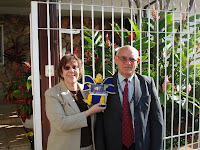
The job of running the embassy falls on the shoulders of the deputy chief of mission. In the case of the U.S. embassy in Brazil, that person is Lisa Kubiske, Dani's aunt. (That's her on the right with her driver from the embassy.)
There are lots of issues the embassy has to keep an eye on. Everything from local elections to military affairs to business deals to local arts and culture need to be covered and reported back to Washington.
Besides the embassy there are three consulates (think of them as branch offices of the embassy) that have staff to keep an eye on local things.
But it is the embassy that has the "big picture" of events in Brazil that are important to the United States.
Most of the employees are in the State Department but others work for the Commerce, Defense, Justice and Agriculture departments. Lots and lots of people are in this embassy -- and embassies around the world -- working to keep the U.S. government informed about what is going on in the world.
Pretty neat work. If you can get it.
I found out that the people in the embassy are from all over the country. (One woman is from northern Michigan. So much for the idea that only East Coast or West Coast people get in.) All they had to do is take a test and pass an interview. (Gee, just like any other job.)
And once they pass everything, they get training in languages and the skills needed to work overseas.
And then they get to live overseas.
How cool is that?
Here is the link to find out how to join the Foreign Service: State Department Careers
Well, gotta go.
I am going to be stuffed back into a box pretty soon and sent off to places yet to be determined. I have heard a lot of possibilities. One is even Iraq! Another is Peru.
I can't wait to see the rest of the world.
This is so cool!

I actually got to meet the U.S. ambassador to Brazil. He took time from his very busy schedule to show me his office yesterday (Oct. 6).
Amb. Clifford Sobel took me into his office where I got to see the office and learn about the kind of work he does.
Let me tell you a little about what an ambassador does.
The short and simple is that the ambassador is the personal representative of the president of the United States.
Back before reliable telephone lines and the Internet whenever a president wanted to communicate with the leaders of other countries, he would send a telegram to his ambassador and he (usually "he" in the past) would request a meeting with the king, queen, prime minister or president of that country.

But even at a time when the U.S. president can pick up the phone and call anyone in the world, ambassadors still have the very important role of delivering personal messages from the president to world leaders.
Some ambassadors -- like Amb. Sobel -- are from the private sector. They are often business or political leaders. They all have special skills or talents that the president thinks will help improve relations between the United States and the host country.
Other ambassadors are professional foreign service officers. Again, these people might have special skills as negotiators or have knowledge of a country to be named.
What both these groups have in common is that it takes the approval of the U.S. Senate to become an ambassador. So you can imagine it is not an easy job to get or do.
Ambassadors spend their days promoting American interests.
Some days it could be meeting with the president of a country in the morning and then with a group of students who want to know more about the United States in the afternoon.
Every day is different.
It sounds very interesting. And it is. But it is also very tiring. Amb. Sobel works very long days. Even when he is on vacation he checks in with the embassy staff to see how things are going and suggests meetings he wants to have when he gets back.
And speaking of the embassy staff, as with any large organization, the ambassador depends on the embassy team to get things done.

The job of running the embassy falls on the shoulders of the deputy chief of mission. In the case of the U.S. embassy in Brazil, that person is Lisa Kubiske, Dani's aunt. (That's her on the right with her driver from the embassy.)
There are lots of issues the embassy has to keep an eye on. Everything from local elections to military affairs to business deals to local arts and culture need to be covered and reported back to Washington.
Besides the embassy there are three consulates (think of them as branch offices of the embassy) that have staff to keep an eye on local things.
But it is the embassy that has the "big picture" of events in Brazil that are important to the United States.
Most of the employees are in the State Department but others work for the Commerce, Defense, Justice and Agriculture departments. Lots and lots of people are in this embassy -- and embassies around the world -- working to keep the U.S. government informed about what is going on in the world.
Pretty neat work. If you can get it.
I found out that the people in the embassy are from all over the country. (One woman is from northern Michigan. So much for the idea that only East Coast or West Coast people get in.) All they had to do is take a test and pass an interview. (Gee, just like any other job.)
And once they pass everything, they get training in languages and the skills needed to work overseas.
And then they get to live overseas.
How cool is that?
Here is the link to find out how to join the Foreign Service: State Department Careers
Well, gotta go.
I am going to be stuffed back into a box pretty soon and sent off to places yet to be determined. I have heard a lot of possibilities. One is even Iraq! Another is Peru.
I can't wait to see the rest of the world.
Monday, October 6, 2008
A meeting and some sightseeing today (hopefully)
'm off for the U.S. embassy in Brasilia today.
The ambassador, Clifford Sobel is back in town after traveling in the States and around Brazil. (Lots of important visitors in the country from the U.S.)
Hopefully Amb. Sobel will be able to take a minute or two from his VERY busy schedule to show me his office and maybe a bit of the embassy.
What I do know about the embassy is that it is VERY big.
And for those who can't remember the difference between and embassy and a consulate...
The embassy is where the ambassador is based. This is the main office in the country for the U.S. government. The consulates should be considered "branch offices" of the embassy.
Usually the embassy is located in a country's capitol. Sometimes (as in the case if Israel) it is not.
Besides the embassy the U.S. government has three consulates in the country: Sao Paulo, Rio de Janeiro and Recife. And of course the embassy is in Brasilia.
Brazil is just a bit smaller than the United States but has many fewer people. (About 192 million as of last year -- or the fifth most populous country in the world.)
About half the country is jungle -- the famous Amazon Forest.
But many parts of the rain forest are under attack as landlords try to expand their farms. The problem is that the jungle soil is not very good for most agriculture. So lots more things have to be done to get the soil prepared for agriculture and in the meantime, new breeding grounds for disease-bearing insects are created and endangered species loose more of their habitats.
Plus there are fewer trees to absorb the growing levels of carbon dioxide, thus leading to more global warming. (At least that is the argument.)
Any way, here are some links to learn more about Brazil:
Gotta run.
Hopefully later tonight I will be able to post some pictures with the ambassador and the embassy.

The ambassador, Clifford Sobel is back in town after traveling in the States and around Brazil. (Lots of important visitors in the country from the U.S.)
Hopefully Amb. Sobel will be able to take a minute or two from his VERY busy schedule to show me his office and maybe a bit of the embassy.
What I do know about the embassy is that it is VERY big.
And for those who can't remember the difference between and embassy and a consulate...
The embassy is where the ambassador is based. This is the main office in the country for the
 U.S. government. The consulates should be considered "branch offices" of the embassy.
Usually the embassy is located in a country's capitol. Sometimes (as in the case if Israel) it is not.
Besides the embassy the U.S. government has three consulates in the country: Sao Paulo, Rio de Janeiro and Recife. And of course the embassy is in Brasilia.
Brazil is just a bit smaller than the United States but has many fewer people. (About 192 million as of last year -- or the fifth most populous country in the world.)
About half the country is jungle -- the famous Amazon Forest.
But many parts of the rain forest are under attack as landlords try to expand their farms. The problem is that the jungle soil is not very good for most agriculture. So lots more things have to be done to get the soil prepared for agriculture and in the meantime, new breeding grounds for disease-bearing insects are created and endangered species loose more of their habitats.
Plus there are fewer trees to absorb the growing levels of carbon dioxide, thus leading to more global warming. (At least that is the argument.)
Any way, here are some links to learn more about Brazil:
Gotta run.
Hopefully later tonight I will be able to post some pictures with the ambassador and the embassy.
Subscribe to:
Posts (Atom)

 Posts
Posts


