Showing posts with label Peru. Show all posts

Sunday, February 22, 2009

Goliatha visits a museum and learns about the Incas

Before the Spanish came Peru has a strong empire and a lot of gold. At its height, the Inca empire stretched from Argentina to Ecuador. You can see on the map to the right just how big this empire was.

The Inca empire started around 1200 AD. It finally faded away by the late-1500s because of the Spanish invaders.

One of the most famous places in Peru from the Inca period is Machu Picchu. In the local language "Machu Picchu" means "OldPeak." It is a pre-Columbian (that means before Christopher Columbus landed in the New World) site located 8,000 feet above sea level.

It is on a mountain above the Urubamba Valley in Peru, about 50 miles northwest of the major city Cuzco. Nearby is the Urubamba River, which is one of the rivers that later becomes the Amazon River.

Machu Pichu was was built around 1460 AD but was abandoned by the Inca rulers a hundred years later at the time of the Spanish conquest of the Inca Empire.

The site was well known by the local people but after the Spanish conquest, Machu Picchu was forgotten by the rest of the world. It wasn't until 1911 that the American historian Hiram Bingham wrote about the site and made it well-known again.

Since 1911 Machu Picchu has been an important tourist attraction. It was declared a a UNESCO World Heritage Site in 1983. There are concerns about the effect of tourism on the site as it reached 400,000 visitors in 2003.

One of the things the Inca were famous for was their gold work. They made jewelry and masks and other decorative items. Some of the things made were to honor the gods the Inca worshiped. Some of the stuff was used for the high leaders of the society. And other items were made to be buried with the leaders.

On the right you can see Goliatha with an Inca gold mask at the national museum in Lima.

Besides gold, the Inca made a lot of beautiful pottery. Here is Goliatha with some of the pottery as seen in the national museum.


Reblog this post [with Zemanta]

Saturday, February 21, 2009

Visiting Lima, Peru

First, I better explain how you pronounce the capital city of Peru.

It is spelled L-I-M-A. It is pronounced LEE-ma. (So it is not like the beans that we all hate. Those are pronounced LIE-ma.)

Charisse Phillips and her family did a great job showing me around the city.

Lima really has a lot of history.

It was founded by the Spanish conquistador Francisco Pizarro on January 18, 1535, as La Ciudad de los Reyes, or "The City of Kings." It became the most important city in the Spanish Vice-royalty of Peru and after independence in 1821 became the country's capital.

Independence was not easy to earn.

The Spanish wanted to keep all their colonies in South America but more and more South Americans wanted independence. Two famous independence leaders were Jose de San Martin and Simon Bolivar. (If you go to Washington, DC you can see statues of these men not far from the U.S. State Department.)

Even though San Martin proclaimed Peruvian independence July 28, 1821, it still took another four years before the Spanish were kicked out of South America and all the countries could have their own governments.

And what we know today as the many countries of South America is not what was around in the 1800s.

What the Spanish thought of as Peru is what we now call Peru and Bolivia. And large portions of Chile. (And if you think the name of the country BOLIVIA sounds like the liberator BOLIVAR, there is a reason. The country was named for Simon Bolivar.)

In 1837 Bolivia and Peru tried to have a joint country but that failed after a couple of years because of attacks from Chile.

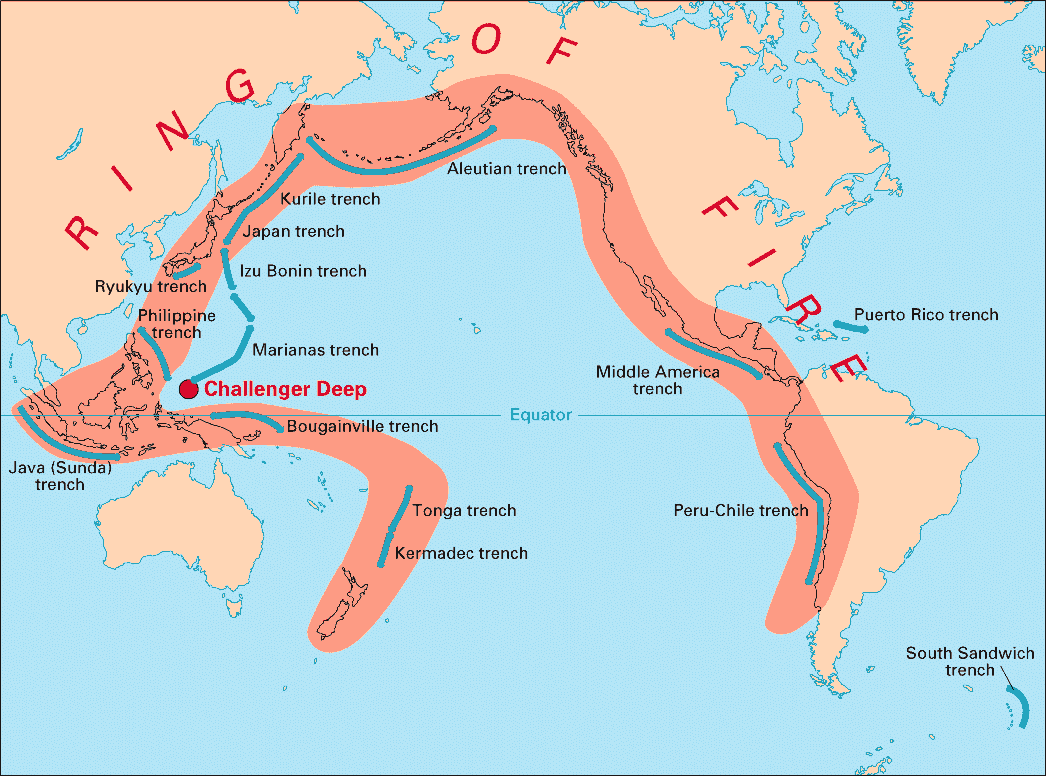
Peru is also along what is called the "Ring of Fire." This means that a lot of earthquakes can happen -- and do.

In 1940 most of the city was destroyed by an earthquake. Other earthquakes happened just about every 10 years in Peru.

Dani's aunt Lisa was in Lima in the 1970s when another powerful earthquake hit.

Earthquakes in Peru have been recorded back more than 400 years, to 1553. The first real description of an earthquake, however, came in 1582. The tales told of a terremoto that killed 30 people and destroyed much of Arequipa.

You can learn more about Peru and its earthquakes here.

For the Catholics among the readers, Lima even has its own saint. St. Martin de Porres was born in 1579 and canonized in 1962.

So, with lots of history to the city of Lima and to the country of Peru, you have to figure there are lots of interesting places to visit.

And you would be right

Here I am at a crypt in the national cathedral. Charisse says this is always a popular place for kids to visit.

And below is a picture of me in front of the cathedral. This was church was started in 1535. So it is really really old.

Because of all the earthquakes the cathedral was damaged a lot and then fixed up. There were also times when money was tight and so some important repairs had to be put off. And we all know that when a problem is not fixed right away it becomes a bigger problem later. So there were times when the cathedral had be be closed because it was too dangerous to let people in.

The cathedral is in the city's main square called the Plaza de Armas.
This is the place where San Martin declared Peru's independence. And when he did that the plaza was already about 300 years old. So the plaza is almost as old as the city.

I'm going to stop here because this is a lot of information for just one posting.

I'll have some more pictures and facts including a neat picture of me with a solid gold mask!

How cool is that?


Reblog this post [with Zemanta]

Goliatha enjoying Peruvian charms

(Here is a note from Charisse Phillips in Lima, Peru. Charisse is Goliatha's host in Peru.)

Goliatha went to the beach for a summer day, just like most Limenos do.

Here she is at Bikini Beach in the town of Punta Negra.

These black rocks were formed by volcanic activity are are super sharp, so Goliatha had to be pretty careful.

The Pacific waves are not at all peaceful here - the waves are quite wild and there's a strong undertow. But Goliatha got to see pelicans, sea gulls, cormorants and Peruvian boobies, which dive deep into the sea for fish. Goliatha couldn't believe that there's a great sandy desert right on the edge of the ocean in Peru. There was nothing green growing on the hills along the road to the beach.

She thought it looked like the Sahara.

Reblog this post [with Zemanta]